
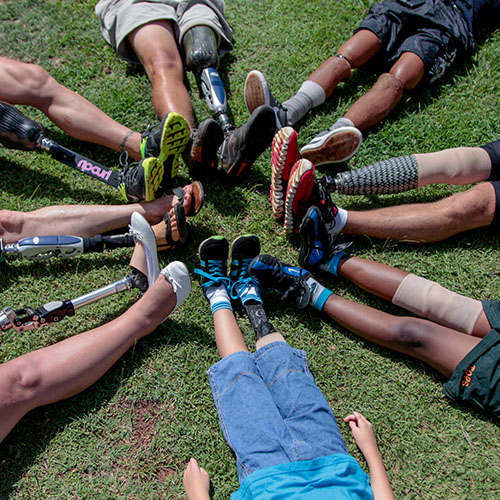
Adjusting to life after limb loss can feel overwhelming, but no one has to go through the journey alone. Across Maryland—especially near Baltimore and Landover Hills—there are strong, welcoming amputee support groups that connect people with shared experiences. These groups offer not only encouragement, but also education, resources, and long-lasting friendships.
At Metro Prosthetics, with offices in both Baltimore and Landover Hills, we’ve seen firsthand how valuable peer support can be in recovery. Our team works closely with local support group coordinators and even guest speaks at meetings to share prosthetic care insights and answer questions. Below, we’ve gathered some of the leading amputee support groups in Maryland, along with their locations, contacts, and the benefits of getting involved.
Local Amputee Support Groups Near Baltimore & Landover Hills
MedStar Good Samaritan Amputee Support Group – Baltimore
-
Location: MedStar Physical Therapy – O’Neill2, MedStar Good Samaritan Hospital, 5601 Loch Raven Blvd, Baltimore, MD 21239
-
Affiliation: MedStar Good Samaritan Hospital (part of MedStar Health)
-
Schedule: Meets the fourth Wednesday of each month, 1:30–3:00 pm. Hybrid format available (in-person or Zoom).
-
Contact: Jennifer McDivitt, PT — 443-444-5304 or Jennifer.McDivitt@Medstar.net
This group offers a safe environment to share experiences and learn coping strategies. Many Metro Prosthetics patients in Baltimore attend, and our clinicians have collaborated with the group to provide education on prosthetic technology and socket comfort.
University of Maryland Rehabilitation & Orthopaedic Institute Amputee Support Group – Baltimore
-
Location: UM Rehab, Ground Floor Therapy Gym, 220 Kernan Drive, Baltimore, MD
-
Affiliation: University of Maryland Medical System
-
Schedule: Meets the third Wednesday of each month, 5:30–7:00 pm
-
Contact: Marianne Sorteberg, PTA — msorteberg@umm.edu or call 410-448-6731
This group is known for its mix of peer support and professional guidance. Guest speakers often include physical therapists, prosthetists, and motivational presenters. Metro Prosthetics has partnered with this group to answer questions about prosthetic fit, wear schedules, and advancements in mobility technology.
Johns Hopkins Amputee Support Group – Virtual
-
Format: Online via Zoom
-
Affiliation: Johns Hopkins Medicine
-
Schedule: Meets the third Tuesday of each month, 12:15–1:00 pm
-
Contact: Ed Lyons, PT — 443-983-1874 or elyons6@jhmi.edu
For those unable to travel, this group provides a virtual space to connect. Its online format is especially helpful for people in Landover Hills or other parts of Maryland who may not have a local in-person group nearby.
Other Maryland Support Groups
While Baltimore hosts several established groups, others across Maryland also provide support:
-
Eastern Shore Amputee Support Group – University of Maryland Cambridge Hospital, Cambridge, MD. Meets first Tuesday monthly, 11:30 am–12:30 pm. Contact: 443-225-7750.
-
Crossroads Amputee Support Group – Dove Point Children’s Services, Salisbury, MD. Meets first Monday monthly, 6:00–8:00 pm. Contact: Gary Moore, 443-750-0827.
-
Adventist HealthCare Amputee Support Group – Rockville, MD. Meets last Thursday monthly, 4:30–6:30 pm. Contact: Farhad Ostovari, 301-412-3481.
Benefits of Joining an Amputee Support Group
Attending a support group can have a profound impact on recovery and quality of life. Here are just a few of the key benefits:
-
Emotional Support & Understanding
Only someone who has experienced limb loss can fully understand the day-to-day challenges. Support groups provide a safe, judgment-free space to share feelings, frustrations, and victories. -
Peer Advice & Practical Tips
From managing skin care inside a prosthetic socket to handling stairs or driving again, members swap real-world advice that can’t always be found in a clinic. -
Education & Resources
Many groups invite guest speakers—prosthetists, therapists, psychologists, and community advocates. Metro Prosthetics often joins these sessions to provide education about new prosthetic technology and tips for maximizing comfort. -
Family & Caregiver Inclusion
Loved ones can attend too, learning how to better support someone with limb loss while also connecting with other caregivers. -
Building Confidence
Hearing stories from others who have adapted successfully can restore hope, boost motivation, and reinforce the belief that independence is possible. -
Hybrid Accessibility
With in-person and virtual options, more people can access support regardless of mobility, location, or transportation barriers.
How Metro Prosthetics Supports the Community
At Metro Prosthetics, we believe recovery goes beyond fitting a prosthetic. That’s why we:
-
Maintain strong relationships with local support group coordinators.
-
Guest speak at meetings to answer prosthetic-related questions and share professional guidance.
-
Encourage our patients to get involved with support groups as part of their overall care plan.
By combining expert prosthetic care with community support, we help our patients in Baltimore, Landover Hills, and beyond feel more confident, connected, and empowered.
Final Thoughts
Whether you’re newly adjusting to limb loss or have been an amputee for years, joining a support group in Maryland can make a meaningful difference. You’ll find understanding peers, valuable education, and a sense of belonging that strengthens recovery.
If you’re in Baltimore or Landover Hills, Metro Prosthetics can guide you to a nearby support group and ensure your prosthetic needs are met every step of the way.
You don’t have to walk this path alone—community is here, ready to support you.


